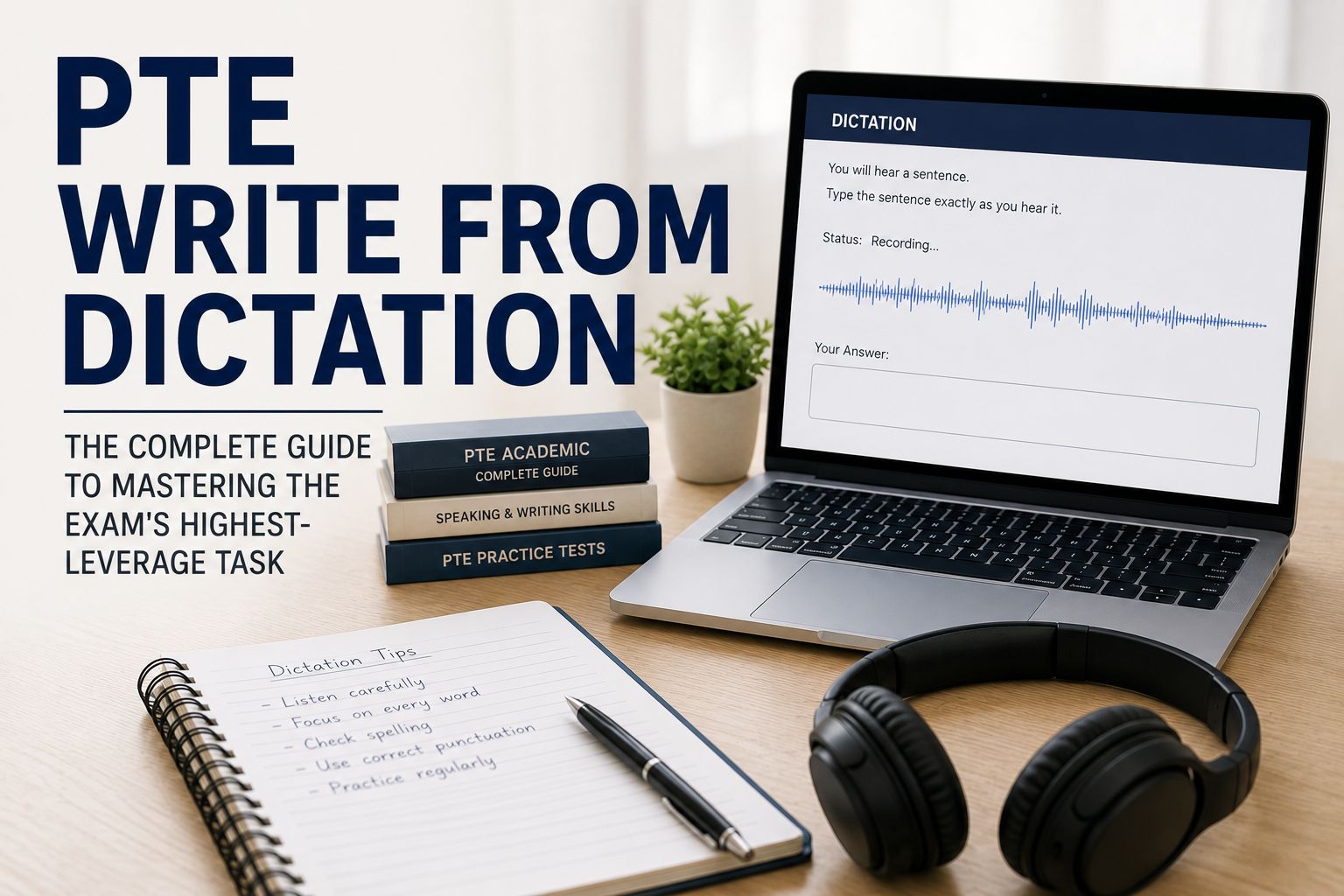
PTE Write From Dictation practice starts here: play a recording, write the sentence, then open the answer and check each word. Try the four short samples below without signing up. These are BandLadder practice recordings, not claims about questions that will appear in your exam.
Try the audio samples · Understand the scoring · Explore 94 extra sentences · Continue in your exam
Four free Write From Dictation audio samples
Use headphones if possible. Write your answer in a notes app or on paper while keeping the transcript closed. For your first attempt, play each clip once. Afterwards, replay it to investigate a mistake. These learning controls allow replay; the real test recording plays once.
This page provides answers and explanations for self-checking. It does not automatically grade or save your response. The first three samples are short warm-ups; the fourth adds a longer academic sentence.
Sample 1: everyday warm-up
Show sample 1 answer and explanation
Please remember to sign in at the front desk.
9 words in this sample. Keep the complete phrase “sign in”. Check “remember” and the article before “front desk”.
Review in chunks: Please remember / to sign in / at the front desk.
Sample 2: campus warm-up
Show sample 2 answer and explanation
The library opens at eight every morning.
7 words in this sample. Listen for the final s in “opens”. The time word is “eight”, not the sound-alike “ate”.
Review in chunks: The library opens / at eight / every morning.
Sample 3: a plural ending
Show sample 3 answer and explanation
Please turn off the lights before you leave.
8 words in this sample. The recording says “lights”, plural. Include “off” and “the”; these short words belong in the sentence too.
Review in chunks: Please turn off / the lights / before you leave.
Sample 4: a longer academic sentence
Show sample 4 answer and explanation
Students are required to submit their thesis proposals before the winter break.
12 words in this sample. Preserve “are required to submit”, the plural “proposals”, and “the winter break”. “Their” shows possession here.
Review in chunks: Students are required to submit / their thesis proposals / before the winter break.
After checking, choose one thing to improve: an ending you missed, a word you misspelled, or a phrase you could not hold in memory. Then try an unseen sentence in PTE Academic Listening or PTE Core Listening.
How Write From Dictation is scored
Both PTE Academic and PTE Core include this listening-and-writing task. Pearson describes a short recording, usually 3–5 seconds, heard once. You reproduce the sentence in writing. Notes on the provided erasable noteboard are allowed.
Pearson counts correct words and awards partial credit. Accurate spelling matters. Longer or rarer words do not receive extra marks under the published word-count description. Do not deliberately discard articles or prepositions to focus only on long nouns.
The instruction is to reproduce the words heard, in order. Adding a list of possible words is not the requested response. Check the official Academic Listening format or Core Listening format for your exam. This guide's format and scoring references were checked on 20 September 2026.
A word-level review example
Sample 3 contains eight words: Please / turn / off / the / lights / before / you / leave. Suppose you wrote: “Please turn off the light before you leave.” You reproduced seven target words, but changed lights to light. Mark that plural ending for review. If you omitted the as well, six target words would remain correct.
These counts help diagnose the example. They are not a conversion to a 10–90 PTE skill score. A result from four practice sentences cannot establish your full Listening, Writing or overall test score. See the PTE score-report and practice-plan guide to distinguish task feedback from the official report.
A practical method: capture, reconstruct, check
- Capture the sentence. Listen for its meaning and its exact wording. Try brief notes for the subject, verb phrase and ending. If notes distract you, compare this with holding a short phrase in memory during practice.
- Reconstruct promptly. Type the words you heard. A sentence about submitting an assignment is not interchangeable with another sentence that has the same meaning.
- Check the small details. Look for missing articles, verb endings, plurals and spelling slips. Read the complete sentence once before moving on.
There is no single note-taking method that every learner must use. Test two approaches with different, similar-length recordings. Compare first-attempt mistakes and completion time, rather than choosing the technique that feels easiest on a memorised sentence.
What to do with your mistakes
- You heard the word but typed it incorrectly: add it to a short spelling list, write it accurately, and revisit it in a new sentence tomorrow.
- You omitted a quiet word: replay the phrase while looking at the transcript, then close the transcript and listen again. Focus on the connection between the words.
- You lost the end of a longer sentence: practise holding two or three meaningful chunks, then work up to longer recordings.
- You replaced the original with a synonym: practise exact reproduction. This task is dictation, not summarising.
- You keep doing well only after replay: record first-listen and review attempts separately. Familiarity with a sample can hide a problem with new audio.
94 extra sentences for partner dictation
These are the sentence-bank examples from this guide, organised into ten groups. They are text prompts, separate from the four recordings above. Ask a study partner to read one while you keep the group closed, or use them for spelling revision. Reading visible text and copying it is not a listening attempt.
The topics provide vocabulary variety; they are not a list of verified upcoming or repeated exam questions. Some sentences are longer or more complex than the warm-ups. Start with a suitable group and build up.
General / Everyday — 15 sentences
- The library closes early on public holidays.
- She left her umbrella on the morning train.
- Please remember to submit your application by Friday.
- The weather forecast predicts heavy rain this weekend.
- He usually arrives at the office before eight.
- The bakery on the corner sells fresh bread daily.
- They decided to postpone the meeting until next month.
- Her flight was delayed because of the storm.
- The children played quietly in the garden all afternoon.
- We need to renew our passports before the trip.
- The new café opened just around the corner.
- He forgot his keys and had to call a locksmith.
- The museum offers free admission on Sundays.
- She spent the entire weekend reorganizing her bookshelf.
- The train was unusually crowded during rush hour.
Academic — 15 sentences
- The professor distributed the reading list at the start of term.
- Students are expected to submit their assignments electronically.
- The lecture covered three major theories of economic growth.
- Researchers collected data from over two thousand participants.
- The university library extended its opening hours during exams.
- Her thesis examines the effects of urbanization on wildlife.
- The seminar focused on recent developments in cognitive psychology.
- Attendance at the workshop is strongly recommended but not compulsory.
- The department published its findings in a peer-reviewed journal.
- Graduate students often balance coursework with independent research.
- The exam will cover material from the first six chapters.
- He revised his hypothesis after reviewing the initial results.
- The faculty approved changes to the curriculum last semester.
- Her supervisor suggested a different approach to the analysis.
- The conference attracted scholars from more than forty countries.
Business — 15 sentences
- The company reported a modest increase in quarterly revenue.
- Negotiations between the two firms concluded without an agreement.
- The manager scheduled a review of departmental spending.
- Shareholders will vote on the proposed merger next month.
- The startup secured funding from several venture capital firms.
- Employees were asked to complete the survey by Wednesday.
- The board approved a new strategy for international expansion.
- Rising costs forced the company to reconsider its pricing.
- The client requested a revised estimate for the project.
- Staff training sessions will resume after the holiday break.
- The merger is expected to close by the end of the year.
- Sales figures exceeded expectations for the third consecutive quarter.
- The firm announced layoffs affecting several regional offices.
- A new supplier was chosen after months of negotiation.
- The committee reviewed several proposals before reaching a decision.
Science and Technology — 10 sentences
- The experiment produced results consistent with earlier studies.
- Engineers tested the new design under extreme conditions.
- The satellite transmitted data back to the research station.
- Scientists identified a previously unknown species in the region.
- The software update fixed several security vulnerabilities.
- Researchers are developing a more efficient method of storage.
- The vaccine underwent several phases of clinical trials.
- The algorithm was designed to detect unusual patterns quickly.
- Engineers rebuilt the bridge using more durable materials.
- The telescope captured images from millions of light-years away.
Current Affairs and General Interest — 5 sentences
- The government announced new measures to reduce emissions.
- Local authorities introduced stricter regulations on water usage.
- The city council debated the proposal for several hours.
- International leaders gathered to discuss the ongoing crisis.
- The organization launched a campaign to raise public awareness.
Health and Medicine — 8 sentences
- The clinic extended its hours to accommodate more patients.
- Doctors recommend regular exercise to reduce long-term health risks.
- The hospital introduced a new system for scheduling appointments.
- Researchers are studying the long-term effects of the treatment.
- Patients were advised to complete the full course of medication.
- The surgery was postponed due to unforeseen complications.
- Nutritionists suggest reducing processed sugar in daily meals.
- The health department issued updated guidelines for public clinics.
Environment and Sustainability — 7 sentences
- The city plans to expand its network of cycling paths.
- Conservationists warned about declining populations of native species.
- The factory adopted new methods to reduce water waste.
- Rising temperatures have altered migration patterns significantly.
- The government pledged to increase funding for renewable energy.
- Local farmers adapted their methods to cope with drought conditions.
- The report highlighted the urgent need for coastal protection.
Law and Politics — 7 sentences
- The court will announce its ruling later this week.
- Lawmakers debated the bill for nearly six hours.
- The new legislation aims to strengthen consumer protections.
- Officials confirmed that the investigation remains ongoing.
- The amendment was rejected by a narrow margin.
- Citizens were encouraged to participate in the public consultation.
- The ministry outlined its priorities for the coming year.
Travel and Transportation — 6 sentences
- The airport introduced additional security checks last month.
- Passengers were advised to arrive earlier due to delays.
- The new train line will reduce travel time considerably.
- Airlines reported a sharp rise in international bookings.
- The city upgraded its public transport network extensively.
- Road closures are expected throughout the construction period.
Arts and Culture — 6 sentences
- The gallery unveiled its latest exhibition to critical acclaim.
- The orchestra performed to a sold-out audience last night.
- The festival attracted visitors from across the country.
- Critics praised the film for its striking cinematography.
- The museum acquired several rare artifacts this year.
- The author's latest novel received widespread critical attention.
A simple seven-day practice cycle
- Day 1 — establish a baseline: attempt the four audio samples once each. Write down the exact errors, rather than only a total.
- Day 2 — spelling: revisit words you heard correctly but could not spell. Finish with fresh sentences.
- Day 3 — short words: listen for articles, prepositions and auxiliaries. Mark what disappeared from your first answer.
- Day 4 — endings: practise plural nouns and verb endings. Compare “light” with “lights”, or “open” with “opens”, in context.
- Day 5 — memory: try short notes and phrase chunks. Keep the audio and task difficulty comparable when testing methods.
- Day 6 — section practice: include other Listening tasks so dictation is not the only skill you train.
- Day 7 — a fresh check: use unseen recordings. Compare first-attempt errors with Day 1 and choose next week's focus.
This is a study routine, not a promised score increase. Do not turn a practice-only time target into an official task limit. Watch the available section time when practising a complete test.
Common questions
Can I practise on a phone?
Yes, the recordings and expandable answers work on a phone. Type in a notes app if you want a written attempt. Also practise with a keyboard before a computer-based test, because phone autocorrect can conceal spelling errors.
Do these samples work for PTE Core?
They exercise the same listen-and-transcribe skill. The everyday samples come from BandLadder's Core collection and the campus examples from its Academic collection. Choose your own exam below for further practice and the correct surrounding task set.
Is there a template that guarantees full marks?
No fixed response can fit different dictated sentences. Learn to reproduce each recording, then use a consistent checking routine. A memorised opening or a longer answer is not a substitute for the words actually spoken.
What should I practise after dictation?
Choose the next task from your mistakes and broader Listening performance. For longer audio, the Re-tell Lecture audio practice develops a different skill: selecting and reporting key ideas rather than reproducing every word. Review the Write From Dictation task overview if you need a quick format reminder.
Continue with the right Listening question bank
Start PTE Academic Listening practice · Start PTE Core Listening practice
BandLadder's wider library includes 25k+ PTE questions and 30k+ IELTS questions, alongside mock tests, AI feedback for supported tasks and prediction resources. These are whole-library counts, not dictation-only totals. Create an account to begin with the available free practice; review plan inclusions for broader access. Prediction resources help structure preparation and do not guarantee which questions will appear.